

In a landmark victory for international cybersecurity, Canadian and U.S. authorities have successfully dismantled the infrastructure behind Kimwolf, a formidable Internet-of-Things (IoT) botnet responsible for record-breaking distributed denial-of-service (DDoS) attacks. The arrest of 23-year-old Ottawa resident Jacob Butler—known online by the handle “Dort”—marks the conclusion of a high-stakes, months-long cat-and-mouse game between global law enforcement and a digital insurgent who sought to hold the internet hostage.
Butler, now in the custody of the Ontario Provincial Police, faces a battery of criminal charges in Canada and remains the target of a U.S. extradition request. His apprehension provides a rare, detailed look into the mechanics of modern cyber-extortion, where a single individual could weaponize millions of “firewalled” devices to cripple global infrastructure, target defense networks, and wage campaigns of harassment against the security researchers attempting to stop him.
The Anatomy of an IoT Menace
The Kimwolf botnet was not merely a tool for disruption; it was an industrial-scale operation designed to exploit the inherent security flaws of modern connected devices. While most users assume that their digital photo frames, web cameras, and smart-home appliances are safely tucked behind firewalls, Kimwolf acted as a digital parasite, identifying and compromising these “invisible” devices.
By building a sprawling network of millions of enslaved devices, Butler was able to orchestrate traffic surges that defied precedent. According to the U.S. Department of Justice, Kimwolf was linked to DDoS attacks measured at nearly 30 Terabits per second (Tbps)—an unprecedented volume that effectively shattered previous industry records.
These attacks were not random; they were calculated, profit-driven, and occasionally malicious. The botnet’s power was frequently rented out to other cybercriminals, but it was also used to launch direct, high-impact assaults on specific targets, including address ranges belonging to the U.S. Department of Defense. The sheer scale of the disruption prompted an intensive investigation by the Defense Criminal Investigative Service (DCIS) and the FBI’s Anchorage field office, signaling that the U.S. government viewed Kimwolf as a Tier-1 national security threat.
Chronology of a Cyber-Insurgency
The unraveling of Butler’s digital empire was the result of persistent investigative journalism and coordinated law enforcement action.
The Rise of ‘Dort’ (Late 2025)
Jacob Butler began his ascent in the cybercrime underground by developing Kimwolf to compete with other dominant botnets like Aisuru, JackSkid, and Mossad. During this period, he became increasingly bold, using his botnet not just for profit, but to settle personal vendettas against those who threatened his operations.
The Unmasking (February 2026)
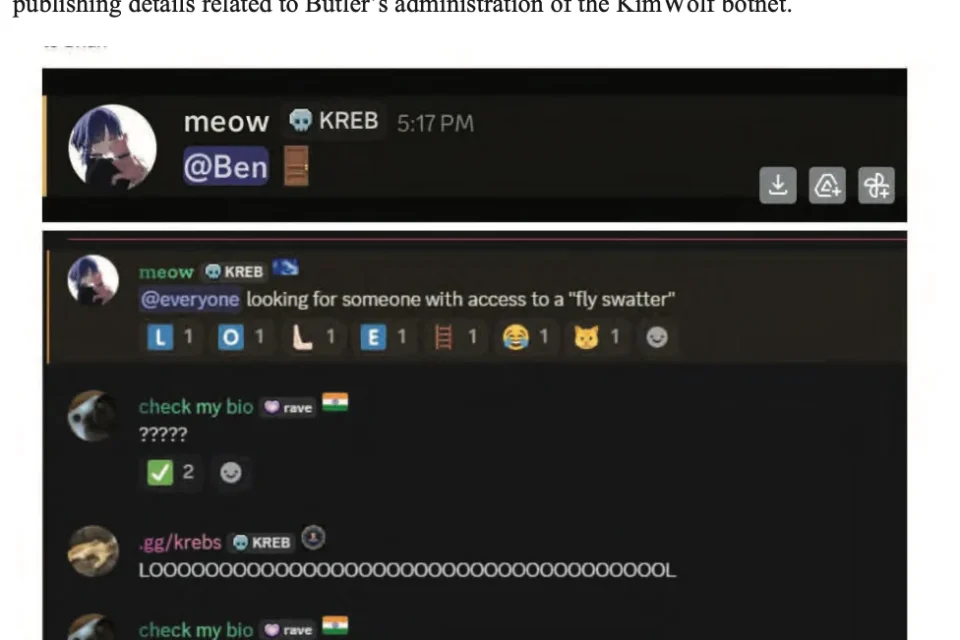
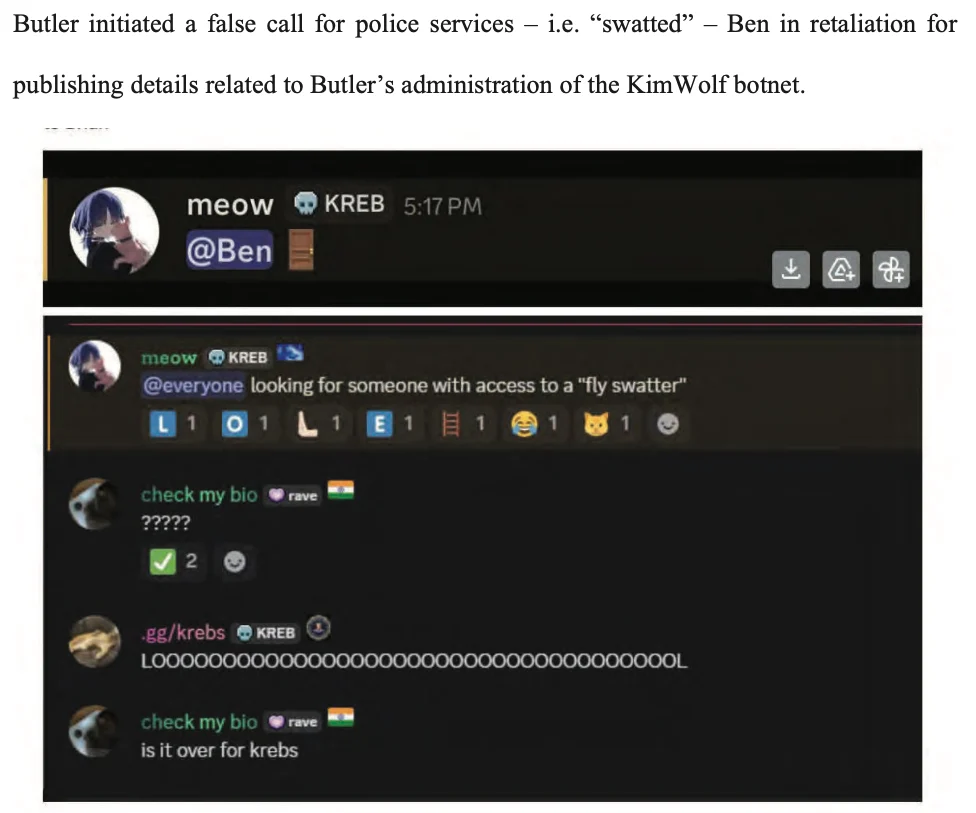
In February 2026, KrebsOnSecurity published a breakthrough investigation that linked the persona “Dort” to Jacob Butler. By meticulously correlating email addresses, forum registrations, and footprints left on Telegram and Discord servers, investigators were able to strip away his anonymity. This exposure, however, triggered a violent reaction; Butler launched a series of DDoS attacks, doxing attempts, and “swatting” campaigns against the researchers and journalists who had identified him.
The Great Seizure (March 19, 2026)
The tide turned decisively on March 19, 2026. In a coordinated multi-national operation, authorities seized the technical infrastructure powering Kimwolf and its three primary competitors. Simultaneously, the Ontario Provincial Police executed a search warrant at Butler’s Ottawa residence, seizing a cache of hardware that would provide the forensic evidence necessary for his arrest.
The Arrest and Legal Proceedings (May 2026)
Following months of processing evidence, Canadian authorities formally arrested Butler this week. He is currently held in custody, awaiting a hearing scheduled for late May. The U.S. government has since unsealed a criminal complaint in the District of Alaska, charging him with aiding and abetting computer intrusion.
The Cost of Chaos: Financial and Human Impact
The impact of Kimwolf extended far beyond technical logs and bandwidth statistics. The Department of Justice confirmed that the botnet issued over 25,000 attack commands, resulting in financial losses for some victims that exceeded $1 million per incident.
However, the human cost was equally significant. Butler’s campaign of “swatting”—falsely reporting a life-threatening emergency at a target’s home to draw armed police response—was used as a weapon to silence his critics. Among his primary targets was Ben Brundage, founder of the security startup Synthient.
Brundage’s firm had played a pivotal role in identifying a critical vulnerability that Kimwolf was exploiting to propagate. When Synthient released information to help secure the internet against this weakness, they became a target of Butler’s fury. Reflecting on the arrest, Brundage expressed relief, noting, “Hopefully this will end the harassment.” The DOJ has publicly thanked Synthient and other tech companies for their cooperation in the investigation, highlighting the necessity of private-public partnerships in modern cyber-defense.
Official Responses and Evidence Gathering
The investigation into Butler was notable for how easily the suspect’s “real-life” identity was linked to his cybercriminal activities. Digital forensic experts noted that Butler made significant operational security (OPSEC) failures, failing to effectively separate his online handles from his personal accounts, IP addresses, and transactional records.
The Ontario Provincial Police (OPP) have been clear about the gravity of the charges, which include:
- Unauthorized use of a computer
- Possession of a device to obtain unauthorized use of a computer system
- Mischief in relation to computer data
In the United States, the Department of Justice is preparing for a high-stakes extradition process. If convicted, Butler faces up to 10 years in federal prison. Legal experts suggest that while the maximum sentence is severe, the U.S. Sentencing Guidelines offer provisions for mitigating factors, such as the defendant’s age, lack of prior criminal record, and the extent of his cooperation with federal authorities.
Implications: The Future of Botnet Control
The takedown of Kimwolf serves as a stark reminder of the volatility of the modern internet. As more household devices become "smart," the surface area for botnet exploitation grows exponentially.
The End of the "DDoS-for-Hire" Era?
The April 2026 seizure of domain names tied to nearly four dozen DDoS-for-hire services represents a broader shift in strategy. Law enforcement is no longer just chasing individual hackers; they are systematically dismantling the marketplaces that provide the infrastructure for these attacks. By severing the link between the "botmasters" and the "attack-for-hire" platforms, the government is attempting to make cybercrime significantly less profitable and more difficult to execute.
The Fragility of IoT Security
The Kimwolf case has reignited the debate over IoT security. The fact that digital photo frames and cameras were used to launch 30 Tbps attacks underscores a fundamental failure in manufacturing security standards. Industry experts are now calling for stricter federal oversight on connected devices, demanding that manufacturers implement "security by design" to ensure that these devices cannot be recruited into botnets the moment they are plugged in.
A Warning to Future Perpetrators
For those operating in the dark corners of the internet, the message from the DOJ and international partners is clear: the wall between digital personas and physical reality is thinning. The arrest of Jacob Butler proves that even the most sophisticated botnet operators are susceptible to traditional investigative techniques, forensic accounting, and, ultimately, the reach of international law.
As the legal process begins for Butler, the cybersecurity community continues to analyze the wreckage of the Kimwolf botnet, hoping that the lessons learned from this massive disruption will help build a more resilient, and less exploitable, internet for the future. The era of the "untraceable" botmaster is effectively over; in its place, a new era of global cyber-accountability is beginning to take hold.